
Moving the Needle and Making a Difference: Inside the Eradicate Hate Global Summit in Downtown Pittsburgh
by Max Scher
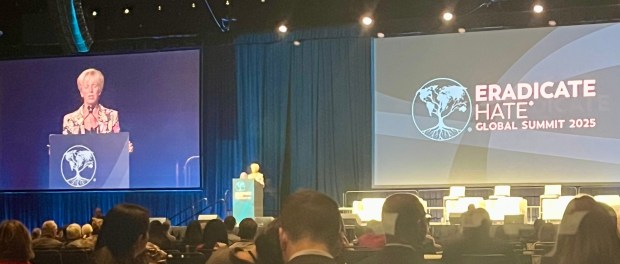 photo by Max Scher
Survivors, scholars, health-care providers, law enforcement, experts, and advocates from across the world gathered at the Eradicate Hate Global Summit Sept. 15-17 with a shared purpose: to confront all forms of hate-fueled violence and reimagine the role of the greater community in preventing it.
Formed just days following the deadliest anti-Semitic event in U.S. history, the October 2018 shooting at Pittsburgh’s Tree of Life Synagogue, the summit was designed to create the “most significant anti-hate initiative in the world,” according to its organizers.
Throughout three days of deeply personal testimony and reflection, similar themes echoed again and again – those of identity and unity.
Dr. Sheila Confer, assistant professor of interdisciplinary studies at Pitt-Greensburg and director of the Academic Village, co-presented a panel on the power of storytelling and the arts in eradicating hate and suggested that, among many other methods, storytelling and personal narrative are essential tools in reshaping identity and undermining the roots of hate.
“To have hate, you have to have that emotion, like the fear, the anger,” Confer said. “If we believe people are bad, we’re not going to believe they can change, and… [therefore] we’re not going to do anything, and we’ll be stuck.”
Survivors, who shared their stories throughout the summit, provided a human face to those cycles as well as to the work of breaking them.
Aaron Stark, a motivational speaker who says he was once “almost a school shooter,” traced that near-tragedy back to a lifetime of abuse, displacement, and isolation.
He described an upbringing of violence and instability that left him drifting through dozens of schools, sleeping in sheds and fields, and finding community among other damaged kids who “workshopped mass destruction.”
That “profound erosion” of self, he said, born of his own self-loathing, fed a campaign of provocation and cruelty meant to prove that he was ultimately only the worst, lowest version of himself.
As Stark put it, “So I was saying the most racist and sexist and disgusting things, not because I was racist or sexist, just because that offended the person I was talking to… if it offended you, I was going to go there, and I didn’t have a limit… I was trying to be as evil and disgusting and offensive as I possibly could to everybody in my life that said they were good.”
His story does not end there. Stark credits small acts of human kindness – a friend who let him sleep in their shed, a surprise birthday party that pulled him back from the brink – with interrupting his spiral.
He framed those moments as proof that hate and isolation can be reversed – indeed, eradicated, when someone shows up: being treated, even briefly, as a person restored a sliver of humanity that derailed his plans for violence.
In the context of the summit, Stark’s trajectory is just one of many that illustrated the chemistry by which fear and anger and even mere misunderstanding become outward-directed hate, and why the gathering’s emphasis on neighbors, allies, and preventative community-level intervention matters.
Dr. Suzanne Barakat, a physician and advocate whose brother, sister-in-law, and her sister-in-law’s baby sister were killed in Chapel Hill, N.C, in 2015 at their dinner table by their neighbor in an Islamophobic attack, reflected more specifically on the role of true allyship in the mission of eradicating hate.
She recalled attending a vigil in the weeks following her family’s death and the deep impact that her local community had on her.
“We embraced, we ugly cried. It was beautiful, and I was reminded that allyship at its core is profoundly human,” Barakat said. “When my community is under attack, I need other communities to stand with me. And when your community is under attack, it becomes my responsibility to extend my hand and lift you up. That is allyship.”
Jennifer Rose Farris, a survivor of a 2009 mass shooting at a Los Angeles fitness center, drew on imagery from nature to describe the collective strength needed to face hate.
“When a storm is approaching, cows tend to run away from the storm, where bulls stand strong and firm and fight the storm,” she said. “So as a community, we need to be the bull. We need to face the storm. We need to stick together, because there is so much power in the community.”
Other survivors, faith leaders, academics, and policy experts alike went even further, framing communities – whether that be spiritual, professional, or geographical – as a tool for prevention, one that could reshape not only narratives of trauma but also the structures that allow violence to flourish.
“Eradicate Hate is more than just a summit,” said Brette Steele, president of Eradicate Hate. “We are building a community of practice. You should now consider yourselves part of it.”
For information about next year’s Eradicate Hate Global Summit, visit the organization’s website here.
 The Insider
Leave a comment