
“Reacting to the Past:” Introducing A New Method Of Learning History
by Mason Sepesky
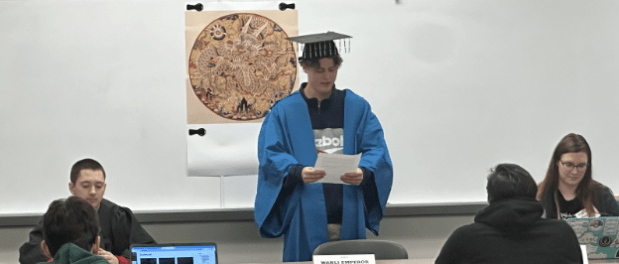 Photographed from left to right: Jeffrey Shire, Jack Fliss, Jordan Gilbert
Photo Courtesy of Mason Sepesky
Photographed from left to right: Jeffrey Shire, Jack Fliss, Jordan Gilbert
Photo Courtesy of Mason Sepesky
Typically, when learning history, students do so by listening to their professor lecture for 50 minutes, three days a week, or an hour and 15 minutes, two days a week, making it tough to become engaged during the class itself.
However, there is a different method of teaching history that is used here at Pitt-Greensburg, and at universities all across the country. “Reacting to the Past,” described as “an active learning pedagogy of role-playing games designed for higher education” according to Barnard College, part of Columbia University in New York City.
Dr. William Campbell, visiting professor of world history, at Pitt-Greensburg, is one of the many professors that use “Reacting to the Past” during their classes. In fact, Campbell’s World History 1500 to Present class, offered on Monday and Wednesday between 4 to 5:15 p.m., and Tuesday and Thursday between 10 to 11:15 a.m., are based on “Reacting to the Past” games.
“Reacting to the Past is a good way to teach history because it helps students care. As historians, we are always studying things because we care about them and because we think they are important,” said Campbell. “However, it could be hard for students to see that, and by connecting them to people of the past it helps them identify something and care more, leading to them paying attention and learning better.”
Anthony Lewis, a senior political science major at Pitt-Greensburg, recommends students to consider enrolling in a reacting class as well.
“Other history classes, such as World History to 1500 are more reading-based, this class is a week or two of reading, and then it’s onto reacting,” said Lewis.
While Dr. Campbell does enjoy playing all of the reacting games that he does during his classes, there is one game in particular that stands out to him.
“My favorite reacting game is still the first one I ever did — The Black Death game,” said Campbell.
Pitt-Greensburg students will have the opportunity to participate in that game during the Fall 2024 semester, in Campbell’s “Black Death: Plague and History” class. The class is scheduled on Tuesdays and Thursdays from 4 to 5:15 p.m.
As for World History 1500 to Present, the entirety reacting based class taught by Campbell, that course will be offered again during the Spring 2025 semester.
 The Insider
Leave a comment